Development Activity in Lekki Free Trade Zone

Oyindamola Ladejobi . a month ago
Dangote Refinery
infrastructure
Lags State Government
lekki deep seaport
Lekki Free Trade Zone
Share this post
Subscribe to our newsletter
Article Summary: The Lekki Free Trade Zone is a strategically located modern free trade district, spanning 16,500 hectares in southeastern Lagos, integrated with the recently operational Lekki Deep Seaport. Conceived in 2006 and regulated by the Nigeria Export Processing Zones Authority (NEPZA), the zone has evolved into a thriving industrial ecosystem attracting multinational and indigenous corporations, regional…
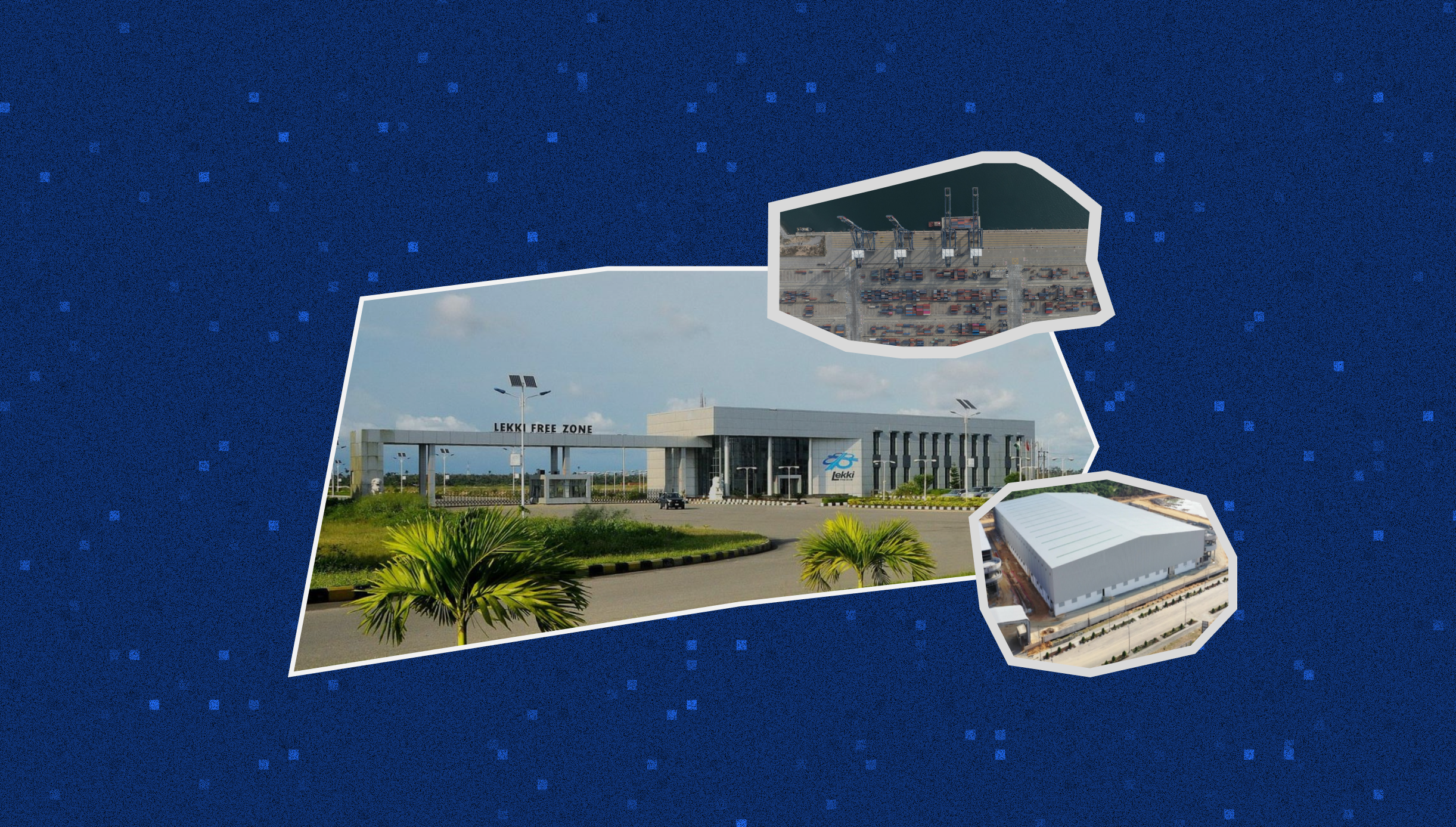
The Lekki Free Trade Zone is a strategically located modern free trade district, spanning 16,500 hectares in southeastern Lagos, integrated with the recently operational Lekki Deep Seaport. Conceived in 2006 and regulated by the Nigeria Export Processing Zones Authority (NEPZA), the zone has evolved into a thriving industrial ecosystem attracting multinational and indigenous corporations, regional investors and international capital. This zone is transitioning from infancy to accelerating growth, with a significant increase in development activity. Estate Intel explores this growth and its drivers in this article.
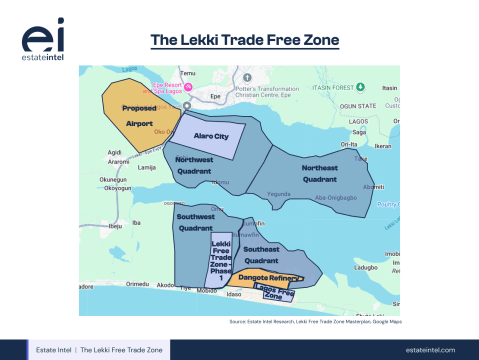
The Lekki Free Trade Zone is located at the boundary of Lagos and Ogun states, connecting to the Atlantic Ocean, boosting seamless connectivity to the ocean through the Lekki Deep Seaport, and to other Nigerian regions through the Lagos-Ibadan expressway and Lagos-Calabar Coastal Road. The zone’s 5-kilometre coastline and direct port access position manufacturers competitively for regional distribution and export.
The zone’s tax-friendly incentives and integration of the Lekki Deep Seaport, which commenced full commercial activities in April 2023, further strengthened the district’s position and competitiveness as a globally competitive industrial park.
Several Factors have contributed to the Zone’s growth
Critical Infrastructure Development
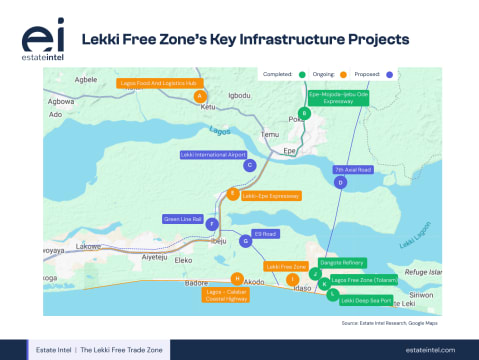
Government interventions to restore macroeconomic stability and policy support, as well as independent actions, have enabled infrastructure development, which is increasingly prioritised as the major driver for sustainable growth. The freezone’s expansion is encouraged by facilities that reduce operational stress for existing and prospective occupiers and investors, as well as its integration with the major regional projects, some of which are highlighted below:
- Lekki Deep Sea Port: This is an important asset for the free zone, providing direct maritime access and reducing logistics costs for manufacturing and export-based businesses in the free zone. It features a container terminal with a 1,200-meter quay, three container berths, and a storage area with over 15,000 container spaces. The port has the capacity to handle 2.5 million twenty-foot equivalent units (TEUs) annually.
- Lekki International Airport: Located in Epe, the airport is envisioned to enhance Lagos’s connectivity and stimulate economic growth. In February 2025, Lagos State Governor Babajide Sanwo-Olu signed an MoU with Summa Group for its construction. The airport is planned to be built on 3,500 hectares of land and is designed for a capacity of 5 million passengers.
- Dangote Refinery & Petrochemical Complex: With a 650,000-barrel capacity, this complex is one of the continent’s largest single-train refineries and is positioned to meet domestic fuel demand and generate substantial revenue.
- Lagos – Calabar Coastal Highway: Spanning approximately 700km, the highway is designed to connect Lagos to Calabar through several coastal states. The first phase, a 47km stretch from Lagos, is already underway.
- A 24-megawatt independent gas plant ensuring an uninterrupted power supply, which is a critical competitive advantage in Nigeria’s energy-constrained environment, increasing the appeal for manufacturers
- The Zone also includes a single window clearance system, The Green Channel by the Nigeria Customs Service, in an initiative to promote trade and economic growth. The logistics tool is expected to reduce cargo clearance time, lower transaction costs, and provide a predictable supply chain to eliminate bottlenecks.
- Increasing Diverse Economic Activity
While initial activities focused on the industries, with existing players such as the TY Danjuma Logistics Park, TG Arla, and Ariel Foods, increased port activity and infrastructure completion are driving investor interest across the logistics, residential, office, and retail asset classes, with a relatively smaller but growing development pipeline. Data from Estate Intel also shows that there is strong occupancy for existing industrial facilities in the Free Zone, and this high performance is driven by new businesses and existing occupiers that are seeking to avoid development costs.
- Incentives and Regulatory Ease
Businesses domiciled in the free zone enjoy substantial financial advantages, such as duty-free imports and exports compared to standard tariffs in other trade districts, streamlined customs procedure, reducing operational delays and bottlenecks.
Investment Activity in The Lekki Free Zone: Rising Government & Capital Markets Interest
There has been a rising interest in the free zone, and some examples are highlighted below, showing global investor confidence.
- In February 2025, the International Finance Corporation committed up to $50 million in equity investment to the Lagos Free Zone Company to support the development and expansion of the Free Zone, with approximately 15% marked for climate-related initiatives. This institutional backing represents confidence in the zone’s growth and stability, and a commitment to ESG initiatives.
- A notable transaction in December 2025 was Chapel Hill Denham’s Fund acquisition of an industrial warehouse in the Lagos Free Zone for N11 billion, demonstrating investor confidence in the zone’s potential.
- A reported 110 hectares of land were sold to 16 investors between January and November 2025, according to a statement from Lekki Free Zone Development Company (LFZDC) Managing Director Dai Shunfa in November 2025
- In August 2025, the Federal Government acquired 200 hectares within the Lekki Free Trade Zone for a National Housing Materials hub aimed at reducing housing production costs as part of the president’s Renewed Hope Agenda. Shows a recognition of the zone’s development potential, while supporting infrastructure development.
The Four Quadrants
The Lekki Free Trade Zone was developed in accordance with a broader 60,000-hectare comprehensive development scheme for the Lekki Peninsula, and the Zone is organised into four quadrants, each with distinct operators and development timelines, while addressing specific economic functions.
Southwestern Quadrant
This 3,000-hectare quadrant serves as the zone’s primary mixed-use industrial area, operated by the Lekki Free Zone Development Company (LFZDC). It features light and medium industries, warehouses and logistics facilities, as well as comprehensive public amenities. It features a 150-hectare startup area, multi-functional spaces including international trade centres, exhibition halls, and administrative facilities. It also includes infrastructure such as the 24-megawatt gas plant and daily water supply systems. This section commenced operations in 2006 and has the largest stock of industrial assets by size.

Southeastern Quadrant
This quadrant is being developed jointly by the Dangote Group and Tolaram Group, a Singapore-based diversified multinational with extensive operations across Africa, Asia, and Europe, and is positioned to accommodate petrochemical-related industries. The operational Dangote Refinery and Fertiliser Plant generates demand for logistics, warehousing and supply chain services within the zone.
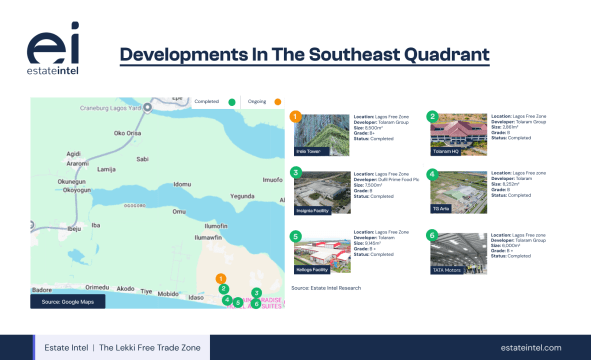
The quadrant, which also hosts the Lagos Free Zone, recently witnessed the launch of the Irele Tower, a mixed-use commercial development by Tolaram Group in April 2026. The project comprises approximately 8,500 sqm of leasable office and retail spaces, and includes amenities such as access control systems and CCTV surveillance.
Northwestern Quadrant
Managed by Rendeavour, this quadrant hosts Alaro City, a 2,000-hectare mixed-use satellite city, developed in partnership with the Lagos State Government, that commenced operations in 2019. The development integrates residential, commercial, retail, industrial, and proposed educational spaces, slightly mirroring the Southwest quadrant as a general mixed-use industrial area. This area currently contains the zone’s second-largest industrial stock, anchored by TY Logistics and Ariel Foods.

Northeastern Quadrant
Currently undeveloped, this quadrant is designed to act as the administrative, business and residential centre for the entire Free Trade Zone, with proposed functions across commercial, residential, community and recreational projects as a mixed-use waterside town.
Our Outlook
The Lekki Free Trade Zone is at an interesting development stage, with a rapidly growing project and infrastructure pipeline. Strong performance from existing commercial assets, completed infrastructure, rising government interest, and institutional capital inflows are creating conditions for an accelerated transformation and recognition into a globally competitive free trade district.
The zone also emphasises Nigeria’s pivot towards internal manufacturing and export-oriented activities. Proximity to the deep seaport, Dangote’s refinery, and the planned airport provides distinct advantages over competing free zones. Planned infrastructure projects such as the Green Line rail system, which is expected to commence construction in 2026, and the ongoing Lagos-Calabar Coastal Highway project will further improve regional access for people and cargo. The Lekki Free Trade Zone is also attracting ESG-aligned deals and environmental standards, signalling more interest for sustainability-conscious investors.
Over the coming years, demand is expected to rise as more infrastructure projects are completed and the economic activity strengthens, both in the primary and secondary markets. For investors, developers and policymakers, the question is no longer about whether to engage, but how to mobilise capital to capture the zone’s growth opportunities.
We love your feedback! Let us know what you think about the development trajectory in the Lekki Free Trade Zone by emailing [email protected].
If you have research requirements or are considering investing in Nigeria’s property market, contact our Capital Advisors team at [email protected].
Related News
You will find these interesting

Bisi Adedun . November 2023
What are the Real Estate and Infrastructure Projects That Were Funded at The Africa Investment Forum
Africa Investment Forum
AIF

Research . February 2022
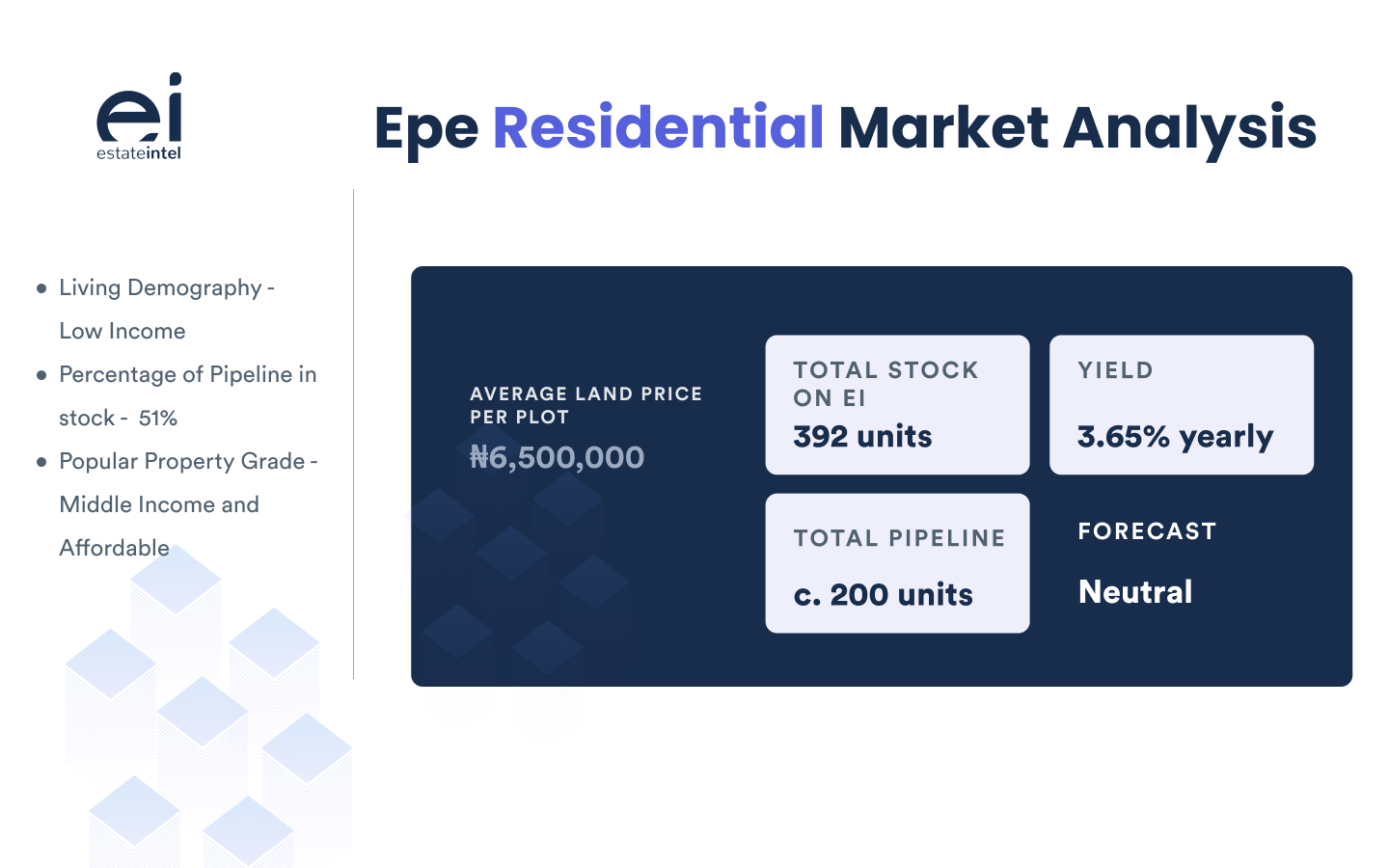
Low Pricing And a Strong Growth Potential is Encouraging Investment in Epe’s Residential Market.
alaro city
epe
Research . November 2021
IFC Partners with Liquid Technologies on a $250m deal to expand Data Centre Capacity in Africa.
data
data centre