Inside the Most Prominent Discount Retail Chains in Nigeria

Chidubem Nwaonicha-Emegha . a month ago
Bokku Mart
Discount Retail
Jara
Nigeria Retail Market
Share this post
Subscribe to our newsletter
Article Summary: In the past two decades, Shoprite dominated Nigeria's formal retail, anchoring large malls as the country's leading retail chain. The anchor store model was that modern grocery shopping should provide a destination experience, somewhere you drove to and spent a long time exploring varieties of products. By 2020, Shoprite controlled 22% of Nigeria's formal retail,…
In the past two decades, Shoprite dominated Nigeria’s formal retail, anchoring large malls as the country’s leading retail chain. The anchor store model was that modern grocery shopping should provide a destination experience, somewhere you drove to and spent a long time exploring varieties of products. By 2020, Shoprite controlled 22% of Nigeria’s formal retail, with the remaining 78% held by indigenous players such as Hubmart, Jara, and Prince Ebeano.
In 2019, citing currency fluctuations, the group announced immediate measures to reduce dollar-denominated rent and borrowings, and limit capital allocation for new stores, signalling further financial strain. By 2020, the South African company sold its stake in Shoprite’s Nigerian subsidiary to Ketron Investments (Persianas), which is currently operated under Retail Supermarkets Nigeria Limited (RSNL). According to recent reports, Shoprite has closed a few of its retail locations, while some branches have low patronage and near-empty shelves.
Recently, Estate Intel observed that rising inflation, weakening purchasing power, and currency depreciation are reshaping how Nigerians shop for everyday items, driving a shift toward neighbourhood-focused discount retail chains.
In this article, we highlight the top six discounted retail chains leading the market.

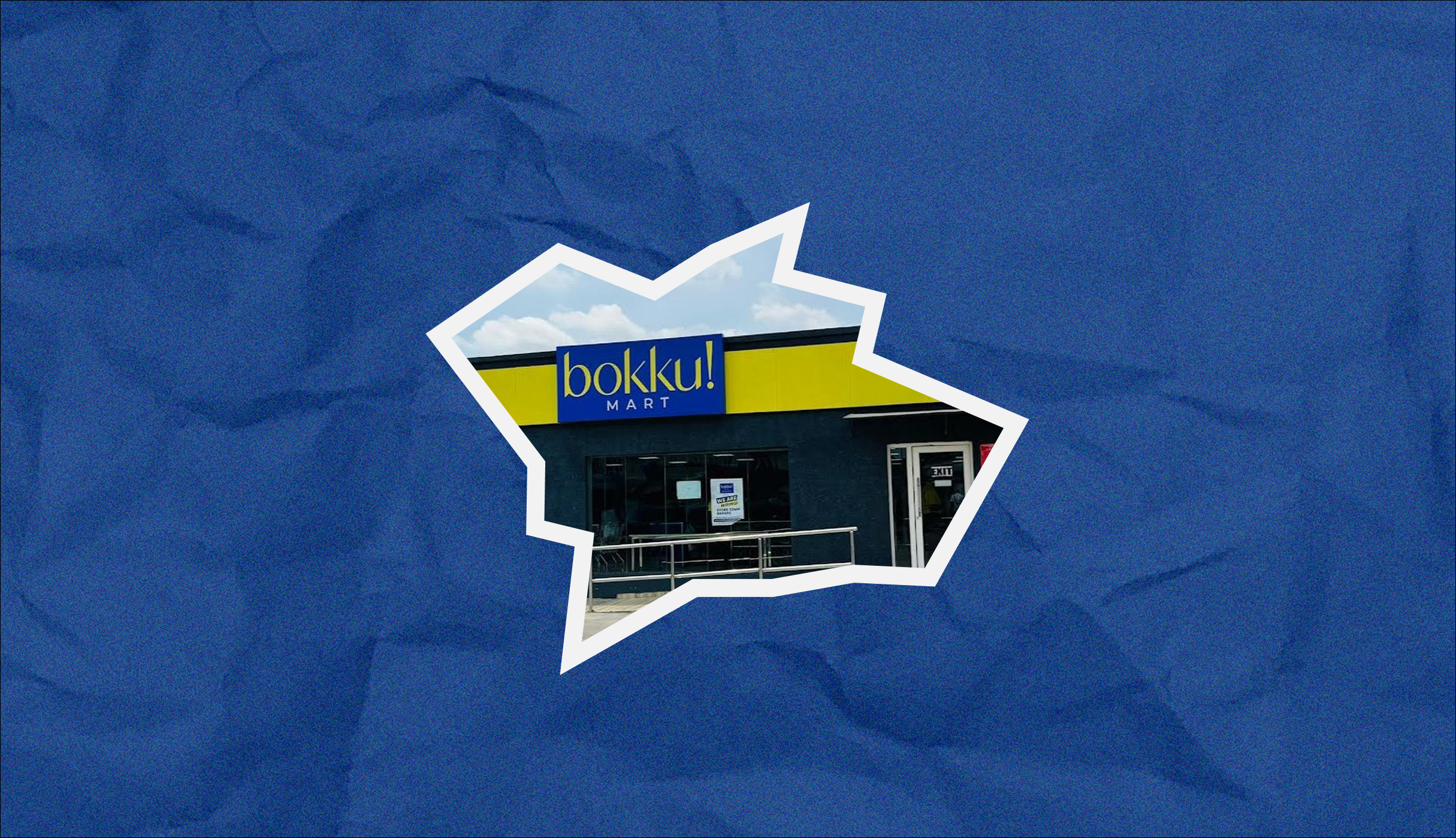
- Bokku! Mart
Bokku! Mart is the latest discounted retail chain in Nigeria, owned by Atreos Limited, a retail investment holding platform that joined the market in 2022. Atreos Limited positions itself as a retail investment holding company, with Bokku! as its flagship asset. Atreos Limited was founded by Adewale Adeyemi, who is a business leader and entrepreneur.
In just 3 years, Bokku! Mart leads the Nigerian market with 200 stores in Lagos, Ogun and Oyo States. On the 15th May, 2026, Booku Stores had the official opening of their 200th store on the ground floor of the Kingsway Building in Marina, Lagos. Each outlet operates on a minimum land size of 600 sqm and a 350m² retail store size, with a policy of one store per neighbourhood. The speed of Bokku’s store rollout suggests institutional capital backing the growth.
Bokku! Mart typically secures long-term leases of 15–20 years, focusing on bare land or ground-floor retail spaces. This micro-format density strategy means Bokku can open in any dense residential area without requiring anchor-mall infrastructure.
Bokku! achieves prices 15–30% below competitors’ by securing massive bulk-purchase discounts and bonuses from manufacturers and passing those savings directly to customers.
- Addide Stores
Addide, owned by Addide Stores Limited, is one of the earliest Nigerian chains to plant itself in the middle-income residential neighbourhoods rather than malls. In March 2008, Addide started operations with its pioneer store at 77 Finbarr’s Road, Akoka.
Addide currently has 44 locations across Bariga, Gbagada, Surulere, and other middle-class residential areas in Lagos. Addide’s commercial strategy focuses on situating small stores within smaller middle-income neighbourhoods in Lagos, Nigeria.
- Market Square (Sundry Markets)
Sundry Markets was founded in 2015. It established Market Square, which has grown into 42 retail outlets across 16 cities in Nigeria. The stores vary from full supermarkets to convenience formats, with a strong presence in Port Harcourt, Benin City, and now expanding into Lagos.
Ebele Enuwa, a former Stanbic IBTC banker, serves as the founder and CEO of Sundry Markets and took a 70% pay cut to found the company. Sundry Markets is backed by private equity investors Tana Africa Capital and Sango Capital. The Sango Fund I partnership in 2022 funded the chain’s scaling from around 10 stores to over 20, creating over 2,000 direct jobs and a largely localised supply chain.
Market Square is a discount shop targeted at middle-class families seeking both price and quality assurance. Currently, the retail chain has the widest geographic footprint in Nigeria compared to others.
- Grocery Bazaar
Grocery Bazaar is another established neighbourhood grocery chain, positioning itself at the intersection of wholesale and retail. It is one of the oldest discount retailers in Nigeria. In 2009, Sam Ejeh founded Grocery Bazaa with a model that captures both household shoppers and small traders seeking wholesale-priced stock.
Grocery Bazaar primarily targets wholesale grocery shoppers in Nigeria by offering bulk purchases at discounted prices. Its hybrid approach, which combines a wholesale and retail approach, enables the company to attract both value consumers and resellers. The chain currently operates across 23 locations, with a strong concentration of warehouse-style stores in Lagos, as well as two additional outlets in Ogun State.
- Everyday Supermarket
Everyday Supermarket is one of Nigeria’s oldest retail chains, incorporated in 2003 as part of the Everyday Group of Companies Limited. Its first outlet, named Emporium 1, opened in 2003 on Omerelu Street, GRA Phase I, Port Harcourt. The flagship store, Emporium 1, spans roughly 1,168 m² across two levels with ample parking space.
Everyday Supermarket is currently situated in 15 locations, most of which are in Port Harcourt, Rivers State, with other locations in Owerri and Anambra State. It has established itself as the dominant supermarket name in Port Harcourt, earning its place alongside Market Square and SPAR as one of the South-South’s most recognised retail institutions.
Dr Charles Dimnwobi, a renowned Port Harcourt-based entrepreneur from Anambra State, is the owner of Everyday Group of Companies. Everyday supermarket differentiates through store size and its dominance in the South-South region, expanding into the South-East region, rather than a multi-city rollout in highly dense areas.
- Jara (EDLP Nigeria)
Jara Nigeria opened its first store in 2019 at the Jara Mall, Ikeja, Lagos. Although the retail chain is Nigerian-owned, the company was founded by Dutch entrepreneur Willem Snollaerts, the former General Manager of Aldi Netherlands.
Jara operates a larger retail format compared to chains such as Bokku! Mart and Addide. Its Ikeja store spans approximately 4,900m², while its Kano branch covers about 2,214m², making Jara one of the largest discount retail chains in Nigeria by average store size. In total, Jar Nigeria has 6 retail outlets in Nigeria.
Operated by EDLP Nigeria Limited, Jara’s mission is to provide high-quality products at affordable prices. The company currently focuses on large-scale discount retail operations in major Nigerian cities, including Ikeja, Benin, Kano, and Ibadan.

Relevance of discounted retail chains in Nigeria
The evolution of discounted retail chains reflects large shifts in Nigeria’s demographics and economy. Recent years show a decisive movement from large destination malls toward local, neighbourhood stores and plazas. Our recent Lagos Real Estate Pipeline report shows that currently, over 40% of active retail pipelines are plazas and hypermarkets and investor confidence in developing large-scale malls is weakening, with over 70% of the pipeline on hold. This trend offers affordable options closer to where people live.
Estate Intel’s research finds that investing in smaller neighbourhood stores is significantly more cost-efficient than leasing large mall spaces. Bokku’s model reflects this advantage: it secures land in naira and develops minimalist (about 200-250sm), modular stores that are quick to deploy, usually within 1-3 months. In contrast, large retailers like Shoprite typically lease dollar-denominated spaces (4,000sqm+) in major malls, resulting in substantially higher operating costs.
Consumer mobility patterns have also changed significantly, becoming an underlying driver for discount retail chains. Households are choosing closeness over experience as oil prices rise from roughly ₦185 per litre in early 2023 to over ₦1,000 per litre in 2026. Instead of paying to go to big malls in central areas, consumers are more likely to walk to local merchants for necessities.
Nigeria’s macroeconomic situation is recovering; however, the main factor limiting consumer consumption is inflation. After base effects and policy tightening, inflation decreased to 15.38% by March 2026 from its peak of 34.80% in December 2024. Nevertheless, consumers are not relieved by this slowdown. The cost of living is still high, food inflation is still high, disposable incomes are declining, and many people still cannot afford necessities.
In conclusion, the emergence of discount retail chains indicates a long-term trend toward accessibility, affordability, and convenience for Nigerian consumers. This is precisely the environment in which discount retail becomes essential infrastructure. As real incomes drop, household spending behaviour shifts from discretionary consumption to strict prioritisation of essentials. The weekly grocery trip is no longer driven by brand preference or shopping experience, but by price sensitivity, proximity, and efficiency. The persistence of these macro-economic pressures suggests that discount retail will remain a dominant theme in Nigeria’s retail landscape in the long term.
We love your feedback! Let us know what you think about Nigeria’s retail market by emailing [email protected].
If you have research requirements or are considering investing in Nigeria’s property market, contact our Capital Advisors team at [email protected].
Related News
You will find these interesting
Chidubem Nwaonicha-Emegha . July 2026
TDC Ghana, GIADEC and Arise IIP Break Ground on Tema Integrated Industrial Park

Chidubem Nwaonicha-Emegha . July 2026
Lagos’ New Addition to Hospitality Market- Ibis Hotel Lekki

Oyindamola Ladejobi . June 2026
Estate Intel Exclusive: Orca Deco is Building its Second Mall in Abuja
itb nigeria
Orca Mall Abuja