Luanda Industrial Market Overview

Linah A. . 2 years ago
Luanda Angola
Share this post
Subscribe to our newsletter
Article Summary: Luanda, Angola's capital, drives industrial investments with major projects concentrated there. The city hosts the country's largest port and has improved transport infrastructure. Industrial areas like Viana and Zee are hubs for activity, attracting domestic and foreign investments. However, challenges such as language barriers, power shortages, and nascent distribution channels hinder optimal performance.
Introduction
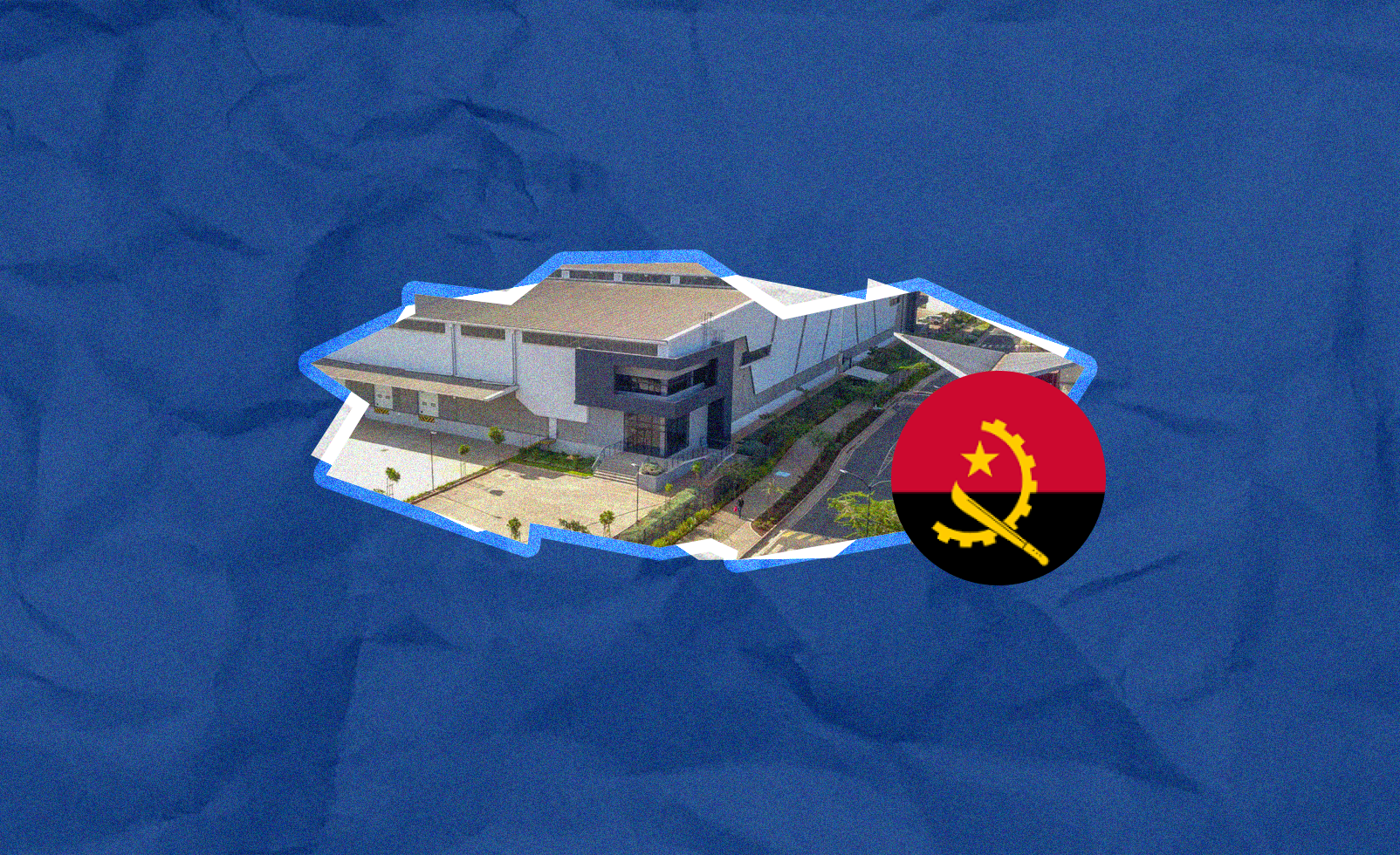
As Angola’s capital, Luanda has played a key role in driving the country’s industrial investments, with over 1.5 million m2 worth of projects tracked by Estate Intel concentrated in the city. Primarily, it hosts Angola’s largest port, the Luanda Port which controls approximately 70% of the country’s imports, a vital point in supporting the industrial sector within and its surroundings. This has been enhanced by infrastructure developments such as the Estra de Catete road, Luanda railway, and the National Road 230 rehabilitation project among others, which facilitate transport services. Needless to say, Angola is the second largest oil producer in Africa, its core economic sector contributing approximately 50% of its GDP, 70% of government revenue, and 90% of the country’s exports. While this is the case, we note that Luanda has a shortage of quality industrial spaces as over 90% of the stock is Grade B and C.
Viana and Zee neighborhoods are Luanda’s major industrial hubs
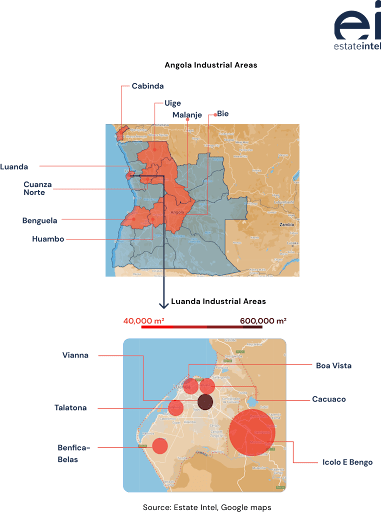
Based on Estate Intel’s analysis, there are over five major industrial areas in Angola, alongside Luanda. These include Benguela, Huambo, Cuanza Norte, and Uige, as depicted below. In Luanda, we note that Viana is the city’s biggest industrial hub, with approximately 44% of the stock concentrated in it. The attraction is mainly underpinned by the presence of major transport networks such as the Luanda-Malenge railway and Estrada de Catete road, both directly linking it to the Luanda Port. Moreover, Viana hosts the country’s largest Special Economic Zone (SEZ)-The Luanda Bengo SEZ which plays a crucial role in attracting both domestic and foreign investments, boosting national production, and has created over 6,000 employment opportunities. Zee and Icolo De Bengo follow, respectively, as other areas tail the aforementioned neighborhoods.
While Luanda has recorded notable industrial activity, we note that various challenges hamper its optimum performance such as language barrier, nascent distribution channels, and power shortages. The country currently has an average of 43% electricity penetration across its various cities, which is very low when compared to other Sub-Saharan countries such as Kenya with an 84% penetration consequently making businesses heavily reliant on diesel. On the brighter side, the government has initiated plans to improve its energy services including solar project implementation, aimed at providing alternative solutions to power shortages.
Estate Intel loves your feedback! If you require more information about Luanda’s industrial market, let the Insights team know by emailing [email protected].
If you require a market study or research, contact our Capital Advisors team using [email protected].
Related News
You will find these interesting


Oyindamola Ladejobi . June 2026
Estate Intel Exclusive: Orca Deco is Building its Second Mall in Abuja
itb nigeria
Orca Mall Abuja


Chidubem Nwaonicha-Emegha . June 2026
Kenya’s Wellness Hospitality Market Sees Growing Investor Interest
Kenya Hospitality Market
Wellness Hospitality
Oyindamola Ladejobi . June 2026
Development Activity in Lekki Free Trade Zone
Dangote Refinery
infrastructure