Updated: FIRS introduces stamp duty on rent, C of O among others

Research . 6 years ago
Share this post
Subscribe to our newsletter
Article Summary: The Federal Inland Revenue Service (FIRS) has introduced stamp duty on rent, Certificate of Occupancy, and other business transaction-related instruments to make them legally binding. The 6% charge applies only to tenancy agreements over 21 years, not all rental payments. Landlords must ensure tenants pay stamp duty; failing to do so may result in the landlord paying the tax.
The Federal Inland Revenue Service (FIRS) in a press release published on July 2nd, 2020, explained that stamp duty will now be paid on rent, Certificate of Occupancy (C of O) as well as other business transaction-related instruments to make the instruments legally binding.
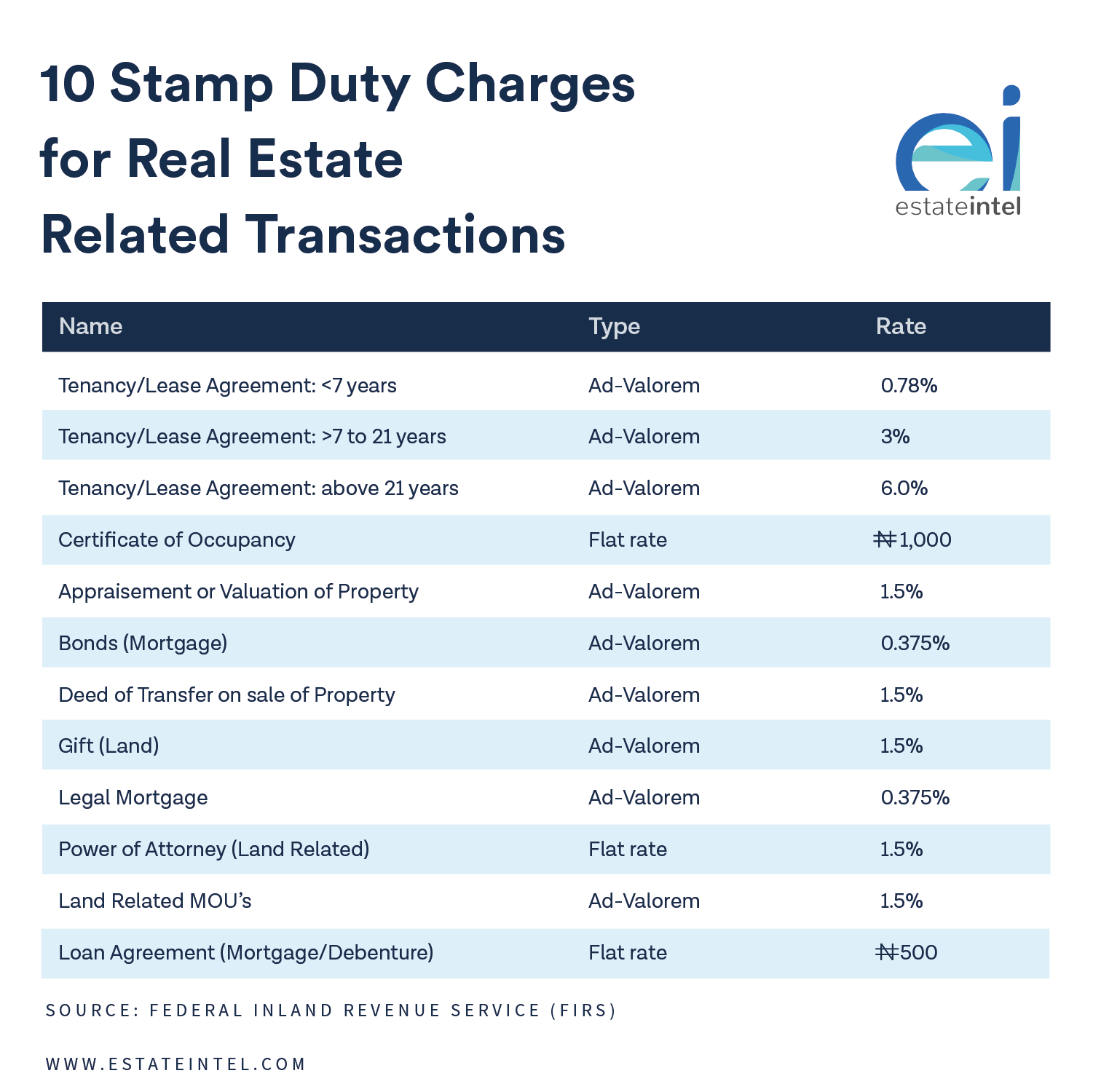
Stamp duty is charged as either ad Valorem (as a percentage of the consideration of the instrument) or as a fixed sum irrespective of the consideration.
It was initially believed that the 6% rate was applicable to all rental payments and this led to a large push back. Executive Director, FIRS, Muhammad Nami, however, clarified that the 6% charge is only applicable to tenancy and lease agreements above a typically uncommon 21 years. See the image below for a complete breakdown.

Speaking on the clarification, Muhammad Nami said:
“It is the responsibility of the landlord before he or she issues a receipt or sign a rent or lease agreement with a tenant to make sure that the tenant presents evidence of stamp duty payment.
“A landlord that does not insist on evidence of stamp duty payment will bear the cost of the stamp duty if the FIRS eventually finds out. You do not pay stamp duty on your own residential accommodation if you are the owner of the property even if you live in a ten storey building.”
As the government seeks to increase revenues, reduce the budget deficit and align domestic tax laws with global best practices, the Stamp Duty Act was reintroduced in the Finance Act, 2020 as it previously did not reflect current economic realities. For context, stamp duties were previously charged on receipts with a value of ₦4 and above and did not take electronic transactions into consideration. The Central Bank of Nigeria (CBN) released a directive in November 2019 for banks to charge ₦50 as stamp duty for transactions above ₦10,000 and these actions by the FIRS are ensuring that real estate-related transactions are not left out.
.
Related News
You will find these interesting


Chidubem Nwaonicha-Emegha . June 2026
Inside the Most Prominent Discount Retail Chains in Nigeria
Bokku Mart
Discount Retail

Chidubem Nwaonicha-Emegha . May 2026
The Future of Workspaces in Lekki Free Trade Zones

Chidubem Nwaonicha-Emegha . May 2026
8 Upcoming Arena Developments in Nigeria
Abia Stadium City
Abuja City Walk