Landmark is betting on growth in 12 Nigerian States and 4 West African Countries

Chidubem Nwaonicha-Emegha . a year ago
abuja
akwa ibom
Cross-Rivers
delta
Enugu
Gambia
Hospitality Sector

Share this post
Subscribe to our newsletter
Article Summary: Landmark Africa, a lifestyle hospitality company, aims to expand into 12 new states across Nigeria, with projects including the revitalization of Nike Lake Resort in Enugu and Port Harcourt Tourist Beach in Rivers State. The company plans to grow into Anglophone West African countries, with a focus on coastal regions, and has set up strategic alliances with local stakeholders to navigate unfamiliar markets.
Landmark Africa, a lifestyle, hospitality, and leisure destination company revolutionising tourism across Africa, faced a setback in April 2024 when a major part of its popular Landmark Beach Resort in Lagos State was demolished to create a right of way for the Lagos-Calabar Coastal Highway project. In its continued pursuit of growth, the company has publicly disclosed several key strategic expansion initiatives. In an exclusive interview, Paul Onwuanibe, the CEO of Landmark Africa, shared insights into the company’s growth strategy, highlighting new locations and the brand’s vision for the future.
Landmark is Planting Flags in 12 New States Over The Next Decade
Landmark Africa is moving to a higher gear with an expansion plan that includes 12 other states across Nigeria, 8 of which have already been revealed to us.
They include Enugu, Rivers, Akwa Ibom, Delta, Plateau, Ogun, Cross Rivers and FCT Abuja. They are also exploring other cities that have demonstrated strong demand for mixed-use developments and lifestyle hubs.

On 16th January, 2025, Landmark Africa Group announced a 35-year lease agreement and an initial ₦10 billion investment with the Enugu State Government to manage and revitalise the iconic Nike Lake Resort. Additionally, the group received approval from the Rivers State Government to redevelop the Port Harcourt Tourist Beach. Let’s dive deeper into these known tourist sites in the works.
Nike Lake Resort, Enugu State
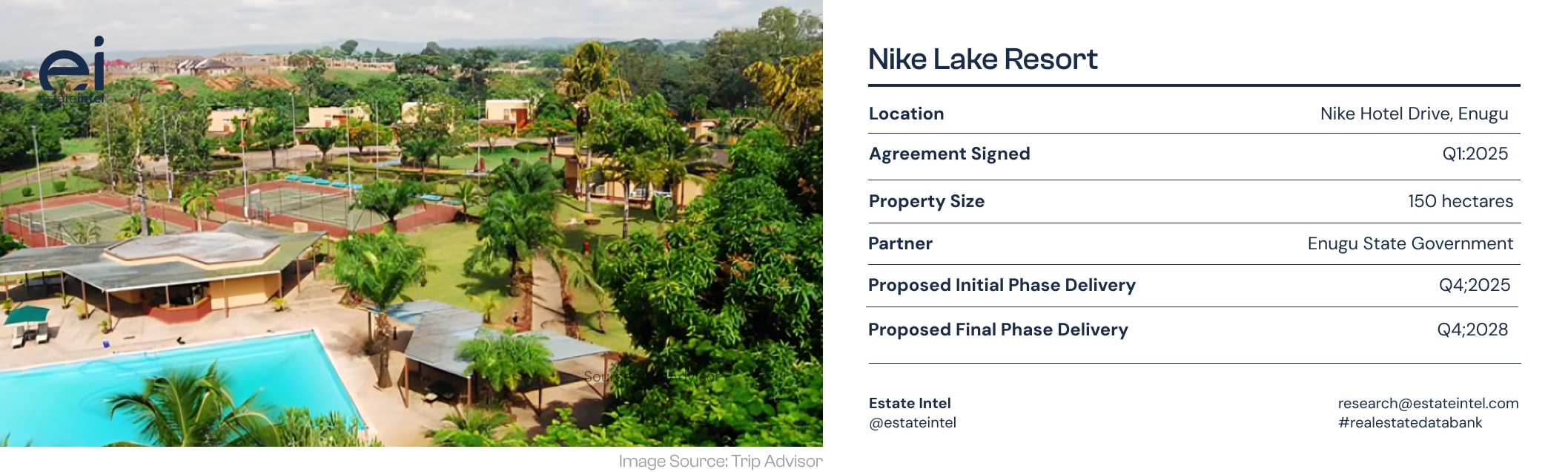
Nike Lake Resort is a hospitality development located in Enugu, Nigeria. Construction commenced in 1987 by the former Anambra State government as part of an effort to develop a world-class tourist destination. The resort encompasses approximately 150 hectares (370 acres) of lush grounds surrounding the serene Nike Lake.
Onwuanibe described the site as an existing facility with over 200 hotel rooms and a historic lake within the site.
“Enugu’s Nike Lake Resort is rich in history and natural beauty. It has been a cherished destination for many reasons, and we see great potential in elevating it to a premier tourist hub,” he explained. Spanning over 100 hectares, the resort was already operational, with 310 staff members and an active guest presence, when Landmark Africa took over on March 1st, 2025.
The transformation of Nike Lake Resort will be a carefully curated process. “The first step is to understand what is working and what needs improvement. We are reinforcing our staff through training, assessing necessary changes, and curating new experiences that align with our vision. Our goal is to make Nike Lake Resort a true destination platform, offering an unparalleled experience in eco-tourism and leisure,” Onwuanibe revealed.

We can see that Nike Lake Resort is conveniently located just 4.9 km on average from Enugu’s key neighbourhoods, ensuring easy access for visitors from both residential and commercial districts.
Port Harcourt Tourist Beach, Rivers State
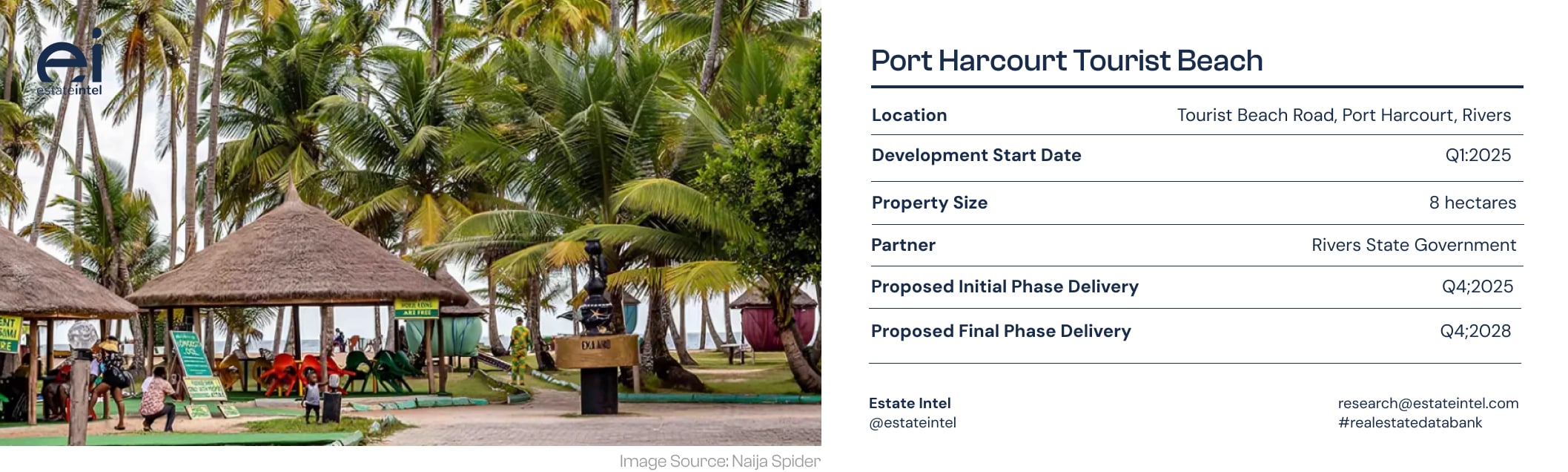
Port Harcourt Tourist Beach, developed in 1988, is an artificial white sand beach nestled along the Kolabi Creek in Port Harcourt, Rivers State, Nigeria. Positioned east of the Old Township district, it provides a peaceful retreat for both visitors and residents.
Onwuanibe outlined the project in three key phases: curation and site preparation, shoreline and waterworks, and construction and operations.
“I look at this in three phases: the first phase is the curation, then the construction phase, and then the operational phase. The first thing was to establish all our community relations, clear out the debris, and begin to buttress the site. We’ve done the first phase of the design as well. We’re looking to begin construction as soon as we finish with the waterworks, you know, because there’s a bit of the water we’ve got to clean, there’s some dredging we’ve got to do, and there’s some shoreline works that we’ve got to do,” he mentioned.

As shown in the map above, Port Harcourt Tourist Beach is a moderate distance from Port Harcourt’s key neighbourhoods, with an average distance of 8.31km, making it fairly accessible for visitors from both residential and commercial areas.
While Landmark Africa confirmed its expansion into several other Nigerian states, the specific project timelines and exact locations were not disclosed. As plans continue to unfold, we hope that more detailed information will be communicated to the public in due course.
The West African Expansion
Landmark Africa has set its sights on Anglophone West African countries beyond Nigeria, including Gambia, Ghana, Liberia, and Sierra Leone.

At this stage of Landmark’s geographic diversification, the focus remains on West Africa rather than the entire continent.
“We have decided to first restrict our expansion to West Africa, specifically to coastal countries along the West African seaboard,” Onwuanibe shared.
Commenting on the choice to avoid Franchophone West Africa and other non-English speaking countries, Paul Onwuanibe explained:
“When starting a process of expansion, you have to expand in places that are familiar to you. You need to find people who think like you, act like you, behave like you, and who like you.”
This decision aligns with Landmark’s mission to take its most profitable sectors—hospitality, leisure, and events into key cities while actively promoting tourism within West Africa by and for Africans.
Landmark Africa Builds Strategic Alliances With Local Stakeholders
Given the unique economic and business landscapes of these new locations, each distinct from the vibrant ecosystem of Lagos, we asked Paul Onwuanibe how he plans to navigate these unfamiliar terrains. He acknowledged that while these cities may be underserved compared to Lagos, every region presents opportunities and challenges.
“I remember a quote that says, ‘Think global, act local.’ Every region, every state, every city, and even every neighbourhood has its opportunities and threats,” Onwuanibe explained. “Lagos is no different, and neither are the cities we are expanding into. The biggest difference is population, but at the core, people everywhere have the same fundamental needs—they need a place to live, to work, and to play. The key is identifying the unique opportunities in each location and figuring out how to leverage them effectively.”
When asked about the strategies Landmark Africa is implementing to navigate these new markets, Onwuanibe emphasised the importance of local collaboration and strong partnerships.
“Our first step is always to find local partners- people who think like us, understand the market, and share our vision. This helps us gain deeper insights into each region and ensures that our developments reflect the unique character of their locations,” he explained. “We also invest heavily in local talent, ensuring that whatever we build is not just an extension of Landmark but a true representation of the communities we serve.”
Beyond just offering premier destinations, Onwuanibe hopes Landmark’s expansion will influence market trends. “We believe we’ll set a precedent in shaping consumer preferences and inspiring others to follow in our footsteps.
The Complexities of Scaling Tourism Across a Broad Landscape
Landmark Africa’s one-of-a-kind project presents a significant case study in the evolving tourism landscape in West Africa. However, we have identified the notable complexities they may encounter during the expansion.
The infrastructural challenges in Nigeria must be carefully considered when planning new tourism destinations. For example, Enugu State faces persistent infrastructural challenges, particularly known for its underdeveloped road networks. Minister of Works David Umahi recently noted that some of the worst roads in Nigeria are found in Enugu. Difficult terrain and unreliable logistics can slow down construction timelines, delay project delivery, and reduce the attractiveness of domestic tourists. Landmark Africa must make substantial infrastructure investments to achieve its vision of a world-class destination.
Like Rivers State, certain regions deal with insecurity and political instability. In March 2025, the President of Nigeria declared a state of emergency, suspending the governor, deputy governor, and all lawmakers, citing ‘prolonged political instability and escalating security threats’. Landmark must cultivate solid ties with the government and the community and ensure political neutrality.
The wide gap in per capita income between Lagos State ($6,614) and Plateau State ($771), as reported by BudgIT’s 2022 State of States, highlights a major challenge for Landmark Africa’s expansion plans. While Lagos offers a financially capable market for world-class destinations, states like Plateau may struggle to support such premium offerings due to lower disposable incomes. This suggests that Landmark must adapt its pricing, scale, and service strategies in lower-income regions to ensure the viability and sustainability of its projects, or risk creating underutilised developments disconnected from local economic realities.
It is also important to recognise that the population size and economic capacity are pivotal factors influencing the potential success of such projects. According to the 2025 World Population Review, Nigeria has an estimated population of 237,528,000 people, while Sierra Leone has 8,819,790 people. In this case, Nigeria has a larger population, providing a substantial domestic market for tourism. This demographic advantage can lead to higher occupancy rates and more consistent revenue streams for tourism ventures. While the Landmark expansion move creates opportunities for regional tourism development, success depends on tailoring strategies to each country’s unique demographic and economic context.
Ultimately, the ability to balance cultural integration and world-class standardisation underscores both the possibilities and complexities involved in revitalising tourism in the region.
We love your feedback! Let us know what you think about Landmark’s new investment destinations by emailing [email protected].
If you have research requirements or are considering investing in Nigeria’s hospitality property market, contact our Capital Advisors team at [email protected]
Related News
You will find these interesting

Chidubem Nwaonicha-Emegha . May 2026
Eyes of West Africa: The New ECOWAS Headquarters in Abuja Has Been Completed and Handed Over
abuja
ECOWAS HQ

Chidubem Nwaonicha-Emegha . August 2025
Top Headquarters Under Construction In Abuja
abuja
Abuja Office Developments

Dapo Runsewe . February 2025
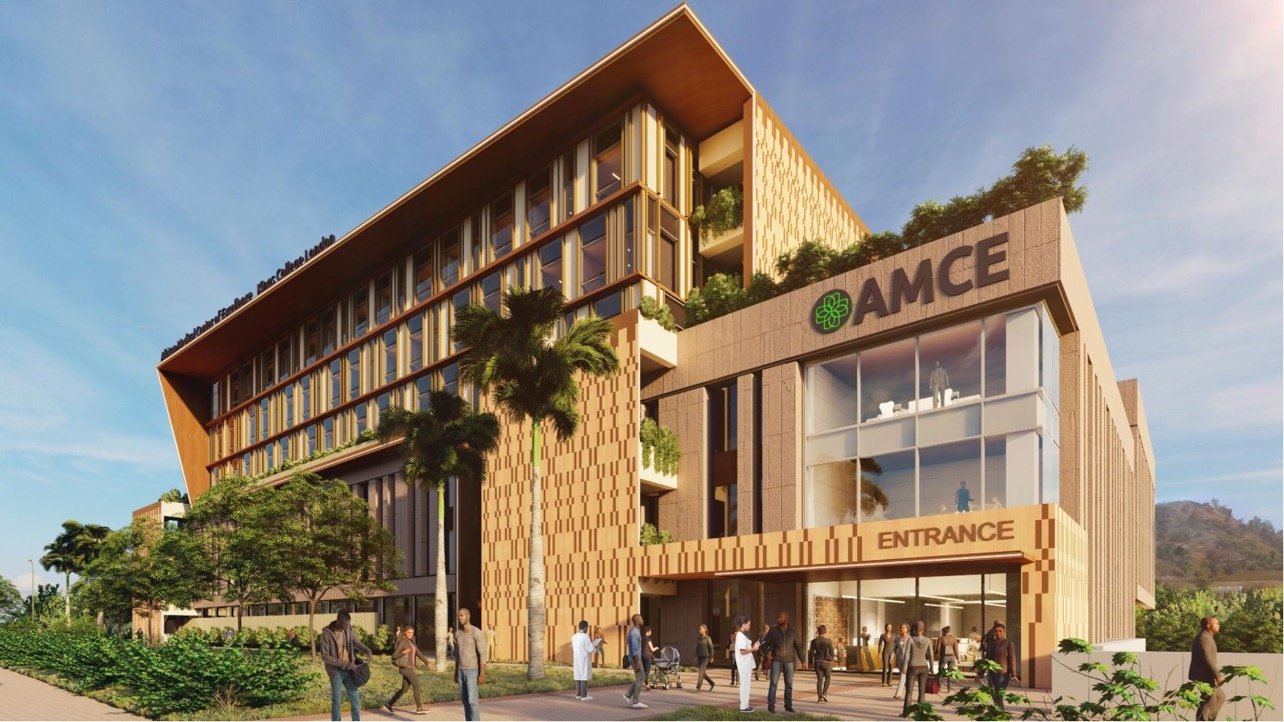
The African Medical Centre of Excellence (AMCE), Abuja – Federal Capital Territory
abuja
africa